
Presentation Skills Observation
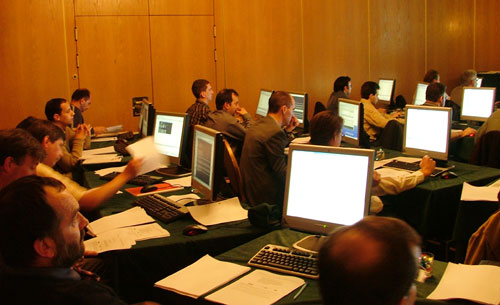
This is my hints and observations after attending a one day ITIL awareness session and saw many speakers at the same day.
- Don’t ever joke or even smile. Be very serious. People expect being very serious.
- Don’t read slides. You are expert in the area of presentation, isn’t you?
- Keep a distance between you and the audience. You are the teacher and they are the students, at least in this session. Don’t let them feel your are friends or you are their servant.
- You are educating your audience. You many even challenge them by questions to keep them awake.
- Asking questions should be at the end only.
- Don’t ask after each slide, “Is it OK to move to next slide?” Move on, you are the teacher. Some attendees are not prepared enough to follow you, you can’t slow down much for them. The other good guys will suffer.
- Use attractive images from nature and may be human pictures, of course if related.
- Use wisdom quotes. It will inspire people.
- Don’t ever show you are tired or disappointed. Be very confident and serious. If you feel that, show the reverse.
- If you are asked to give them the presentation (i.e. PowerPoint presentation file) (and there is no problem). Give it to them but let them feel a favor. I mean, let them feel they are getting a valuable asset.
- Don’t ever slow down. You should move on to keep the flow of conversation. and to keep time. Keeping time is your own responsibility. Everyone will blame you if you did not.
- Don’t ever give a speech in a subject you feel you are not expert in it.
- You own the slides. Even if prepared by someone else, you must tailor it, practice it and test yourself before the training session.
My hints focused on giving training or session to strangers that most of them you are seeing them the first time. Many of these points are not applicable to in-house sessions/training where everyone know everyone else.
From ahm507.blogspot.com
Comments
Comments are closed. These were left on the earlier version of this blog.
Godfather of Practical Reasoning
I agree with many of your observations, in particular #2 and #13.
I differ with you on a few.
#1. I do agree that we shouldn’t tell jokes. It may be okay only if the joke has something to do with the presentation and only if we practice it and it is second nature to us. Much better is to tell a humorous story about ourselves, but again, it must be appropriate to the speech.
Before continuing, I would like to preface this response that I’m discussing how we should give presentations in United States. Presentation customs and traditions may be different in other countries.
When I teach communication skills, I always emphasize two things: eye contact and smiling. Smiling and eye contact are two simple ways to engage the audience. Confidence, gives us command of the stage, regardless if we smile or not.
#3. Many presentations are given from behind the lectern which provides a “safe” distance from the “students,” but if you see professional speakers, they step out from behind the lectern and engage the audience with eye contact and openness. Again, confidence, more than anything else, separates the teacher and the students.
#4. You are correct in that “You are educating your audience.” To keep the audience awake, questions are one way, but there are other ways to do the same such as role play, breakout sessions, etc.
#5 & 6. Normally, most presenters ask for questions at the end of their presentations. You are right in that we definitely should NOT ask the audience after each slide. However, when I am giving a presentation, I ask questions after each main topic. Generally I will have 3 to 5 main topics. At the end of the last main topic, I ask for questions and then go to my final conclusion which, hopefully, will be a call to action.
#8. Wisdom quotes are very good. I would also suggest to tell a personal story. Many top speakers will suggest to make a point, tell a story, make a point, tell a story, etc. Many times, the point is not remembered, but the story is remembered weeks, month, and even years later.
#9. Very important. Confidence is so important to have command of the stage.
10. I’m not sure of “Give it to them but let them feel a favor.” We are there to give the students something. I don’t feel that acting as if it was a favor is proper. Contrarily, I would focus on giving them the very best regardless if you were asked or not. That is, do not practice if asked to give a presentation. Always act as if your presentation is the most important speech you will ever present. If you consider that you are favoring them with your presentation, you may not give your very best.
#11. You are absolutely correct. Staying on time is essential for a successful presentation.
12. “Don’t ever give a speech in a subject you feel you are expert in it.” I don’t understand this. Is it possible that you meant the opposite? You really need to understand what you are discussing. If you are not an expert in the topic — then become an expert before delivering a speech.
#13. Absolutely correct. I would add only one more thing. If your slides do NOT enhance your presentation — don’t use it.
Frank S. Adamo
frank@fsadamo.com
Ahmed Hammad
I made some revisions in red color that will make understanding my intention easier.
I like your idea of “telling stories” (#8) very much. I saw its effectiveness in many situations. If it can be linked with a picture it will be even stronger.
Regarding smile, I still believe it should not be a wide smile and should not be very frequent. My job in presentation is not to make them feel happy but to educate them. Of course the situation will be different if you want to sell them something or want to entertain them.
Also, I have to admit my notes are related to my experience here in Egypt.
Ahmed Hammad
I totally agree on eye contact, but smiling should not a wide smile and should not be very frequent in my opinion. It generally could be interpreted as a fool smile, especially if they think you are not mastering the topic fully.